Crónica de la final de fútbol once femenino en Cochabamba
Entre el 4 y el 9 de diciembre de 2017, Cochabamba没必要 Prediction became the host city of the XXIII Juegos Sudamericanos Escolares. Delegations from several South American countries competed in disciplines such as athletics, volleyball, basketball, swimming, cycling and football, with thousands of students representing their schools and regions. Among the most anticipated matches was the final of the women’s football 11 tournament.
The women’s football final was also an important part of the official multimedia archive of the event. The photographs, competition videos, published schedules and results allow the match to be revisited today as a record of school sport, regional competition and the participation of young female footballers. Bolivia and Colombia provided the protagonists of a final held in an atmosphere charged with national pride and institutional support.
Bolivia and Colombia in the grand final
Bolivia and Colombia reached the decisive match of the women’s football 11 tournament with the ambition of adding a major title to their respective delegations. The final brought together two teams with different tactical profiles but a shared commitment to representing the countries participating in the XXIII Juegos Sudamericanos Escolares.
For the Bolivian delegation, the match had a special meaning. Playing at home in Cochabamba offered the players the backing of their families, teachers, schools and sports authorities. The pressure of a final also brought added responsibility, since a victory would place the country at the summit of the continental school football competition.
Colombia arrived as a worthy opponent and maintained its competitive identity throughout the encounter. The final was not a one-sided affair: Bolivia sought solidity and efficiency, while Colombia attempted to impose its preferred rhythm through ball circulation and positional play. The combination of those approaches produced a match that remained tense until the closing stages.
The final experienced from the stands
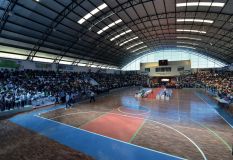
The decisive match was held at the Félix Capriles stadium, one of the principal sports settings used during the Games. The presence of students, coaches, family members and supporters gave the meeting a distinctive school-games atmosphere. National colours appeared around the field, while drums and voices accompanied the most intense moments of the action.
During the first half, both teams studied their opponents and avoided unnecessary risks. Bolivia defended with compact lines and sought to accelerate whenever it recovered possession. Colombia, meanwhile, tried to create passing sequences and move the ball toward the areas where its forwards could receive between the lines. Clear chances were scarce, but neither side was willing to abandon its game plan.
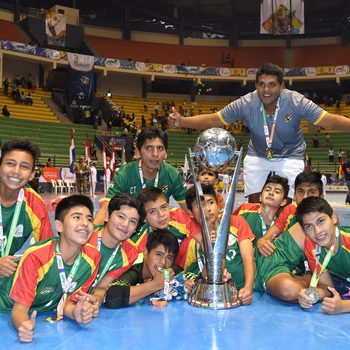
A decisive move allowed Bolivia to obtain the advantage that would prove fundamental. The Colombian team continued pressing and searching for an equalizer, forcing the winning side to remain alert. Bolivia protected its result with collective work, commitment and a willingness to contest every ball, until the final whistle confirmed the Bolivian championship.
Two routes to the decisive match
The final was the outcome of two different journeys through the tournament. Bolivia combined discipline, physical intensity and a willingness to attack spaces. Its strongest performances came from collective organization: the defensive lines stayed close to one another, and rapid transitions allowed the team to surprise opponents.
Colombia relied more heavily on ball control and structured attacks. The team’s passing allowed its players to move between different attacking positions, while individual duels and set pieces offered alternatives when the initial buildup became difficult. The Colombian delegation also brought the experience of competing in several school and youth categories.
Both finalists had to manage the demands of the competition, including recovery from previous matches, travel within the host city and the demands of combining sport with school responsibilities. The final tested not only physical condition but also concentration, tactical understanding and emotional control. Bolivia’s championship reflected a collective performance in which the decisive intervention came when the team needed it most.
| Dimension |
Bolivia team |
Colombia team |
| Feature in attack |
Quick transitions and direct use of open spaces |
Passing sequences and positional circulation |
| Defensive approach |
Compact lines, anticipation and collective pressure |
Balanced marking and attempts to regain possession |
| Decisive factor |
Efficiency in the crucial attack and strength in the final minutes |
Persistent pressure and territorial control |
| Final balance |
Champion of the women’s football 11 tournament |
Runner-up and finalists of the school competition |
The tactical duel and the collective signature
Bolivia’s plan was based on order and concentration. By defending close together, the players reduced the space available to their Colombian rivals and attempted to force the attack towards less dangerous areas. When possession changed hands, the transition began quickly, with runners moving forward to support the ball carrier.
Colombia sought greater control through short and medium passing. The movement of its players stretched the Bolivian defensive block and created opportunities from wide areas. As the match progressed, Colombia increased its attacking ambition and relied more heavily on substitutions and set pieces to find the opening that would have changed the score.
The championship also lacked a single protagonist. The goalkeeper’s interventions, the defenders’ recovery runs, the work of the midfield and the forwards’ finishing defined a collective success. Bolivia’s players understood how to respond when pressure increased, combining concentration with the confidence required to defend a narrow advantage in front of its supporters.
A title that transcends the result
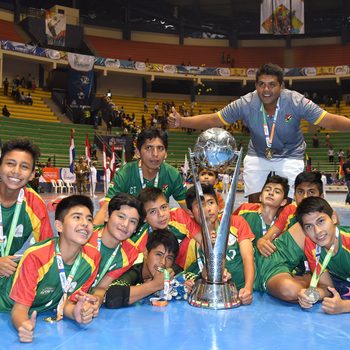
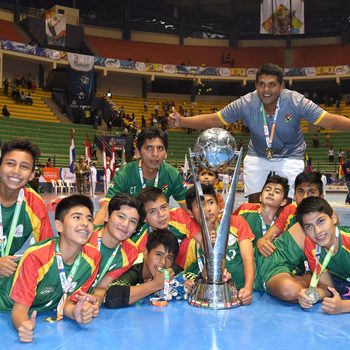
For the participating students, the final represented far more than a sporting result. The Games allowed young athletes to compete at an international level while representing a school, city and country. Victories and defeats were accompanied by classroom obligations, family support and the formative value of representing a community.
The women’s football 11 tournament also highlighted the growing importance of female participation within school sport in South America. More opportunities for girls to train, compete and travel internationally contribute to broader access to physical education and to the development of female sports programmes.
The official archive preserves that significance through images of the competition, award ceremonies and team celebrations, as well as video recordings of the matches. These resources document an edition of the Games in which football connected school identity, national representation and the promotion of women’s sporting roles.
Recommended tour of the official multimedia archive
The official Cochabamba 2017 site offers several complementary ways to revisit the women’s football 11 tournament and the wider event. A careful route through its contents makes it possible to understand both the final and the competition that preceded it.
- Consult the official schedule to locate the matches, competition phases and times connected with women’s football.
- Review the photographic galleries to see the teams, supporters, ceremonies and decisive moments recorded in Cochabamba.
- Watch the available videos to revisit the final, celebrations and other highlights from the XXIII Juegos Sudamericanos Escolares.
- Check the results and regulations to place the football final within the complete structure of the tournament and the Games.
Visit the official event archive from its homepage and follow the football section to discover the complete record of the final. Share the match with students, teachers, former athletes and supporters who witnessed this chapter of South American school sport.







 Argentina
 Bolivia
 Bonaire
 Brasil
 Chile
 Colombia
 Ecuador
 Paraguay
 Perú
 Surinam
 Uruguay